PIP Assessment Prep (£39.99) prepares you for the spoken assessment rather than the form: from what you tell it, our system builds the questions an assessor is likely to ask you, model answers in your own voice, the follow-up questions they use to dig deeper, a printable one-page cheat card and a practice mode that reads the questions out loud. The screenshots below are one real Assessment Prep in the current look, made on 19 November 2026 for an example claimant called Sam, whose details are made up.
Prefer to watch? The full demo is here.
Struggling to put your difficulties into words?
PIPexpert turns how your condition affects you into the detailed answers the PIP2 form actually asks for. See it work on one activity, completely free.
Try one activity free →- Price
- £39.99, a one-off payment with no subscription. The first two questions are free, for one activity you pick.
- Ready in
- About a minute after you send your details.
- What you get
- Sixteen sections, practice for all 12 PIP activities, a practice mode, a printable cheat card and, if you give your date, two calendar reminders.
- Where it arrives
- On the page, as two PDFs (your prep and your cheat card) and as a copy to your email.
- Works for
- First claims and award reviews; phone, video and face to face assessments.
- What it is not
- Answers for the PIP2 form. Those come from Done For You.
What you fill in
You describe your conditions and how they affect you day to day, including medication and side effects, then the aids you use, how many bad days you have a week, falls in the last year, who you live with, whether you work and whether this is a first claim or an award review. You tick your assessment format (phone, video or face to face, or all three if you are not sure) and can add the date and what worries you most.
One optional box matters more than it looks: the key points of what you wrote on your PIP form. The assessor checks what you say against your form, so the prep writes its answers to agree with it. If you built your form answers with PIPexpert on the same device, the prep offers to use them.
Sam listed fibromyalgia, depression and lumbar disc degeneration, a face to face assessment, a walking stick, perching stool, shower seat and raised toilet seat, pregabalin, sertraline and co-codamol, and a partner, Alex, who helps. If your description covers only a few activities, the page asks three short optional questions first (how far you can walk on most days, which everyday things are hard and the assessment format), and your answers go in as your own sentences.
What arrives: the prep page, two PDFs and an email copy
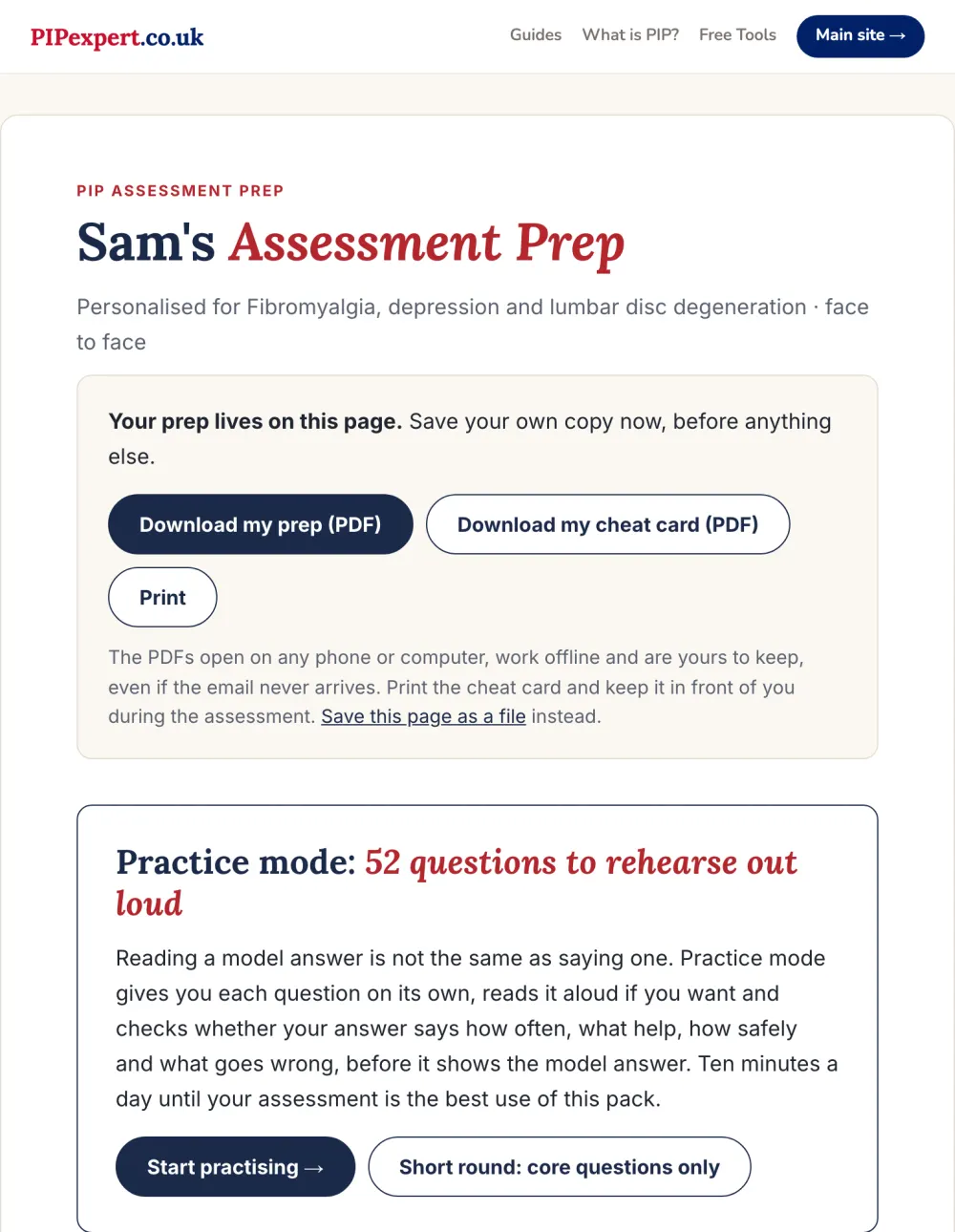
The prep opens on the page with two download buttons, one for the full prep and one for the cheat card, and the practice mode at the top.
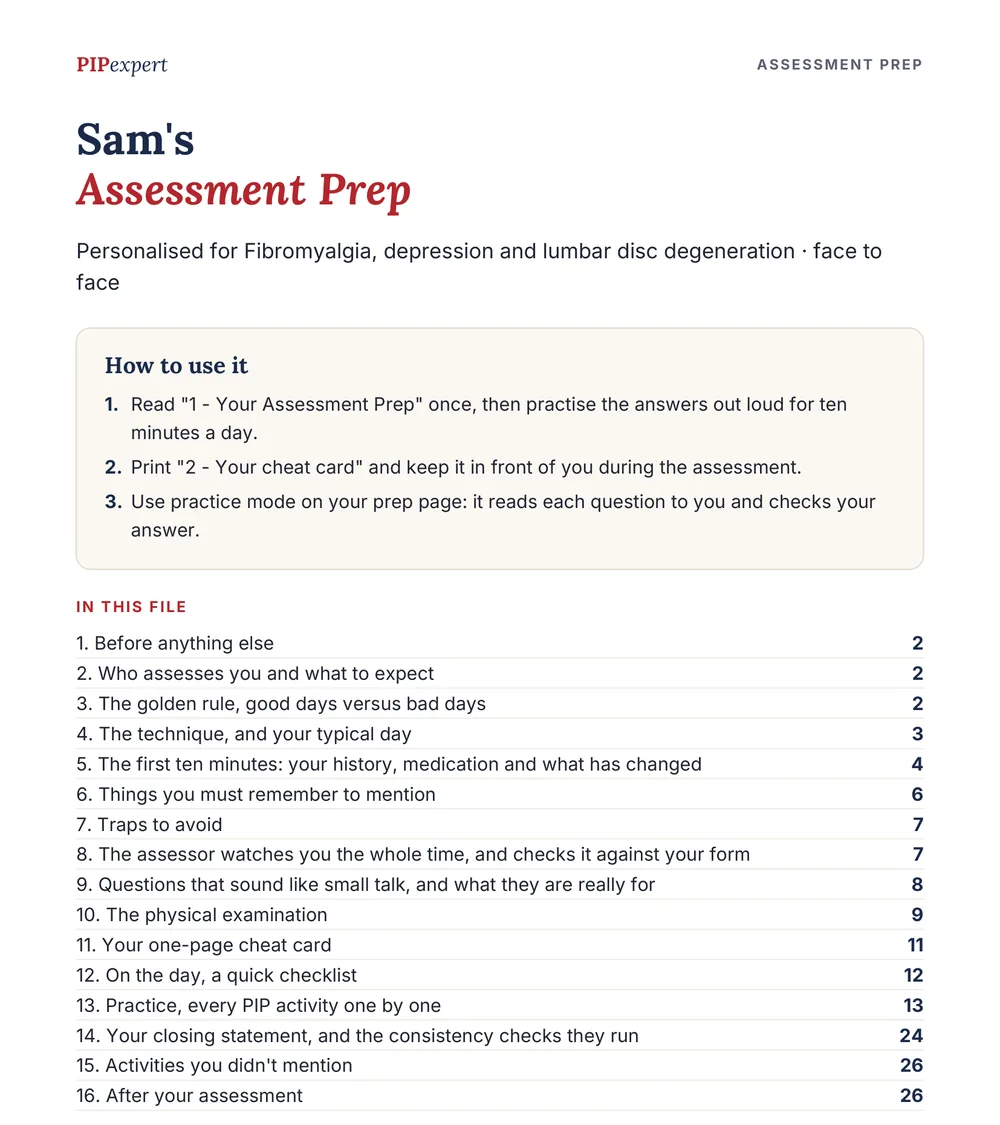
The first PDF, "1 - Your Assessment Prep", starts with how to use it and a contents page:
A copy also goes to your email, and the prep stays on the page so you can save it again.
Practice for every activity: the question, the follow-ups and the trap
Section 13 works through the PIP activities one at a time, as an assessment does. Each card has the question the assessor usually opens with, what they are deciding ("What they're really checking"), a model answer in your voice ("You could say"), a tip, a chain of follow-up questions with answers and a "Watch out" line on the answer that would undersell you.
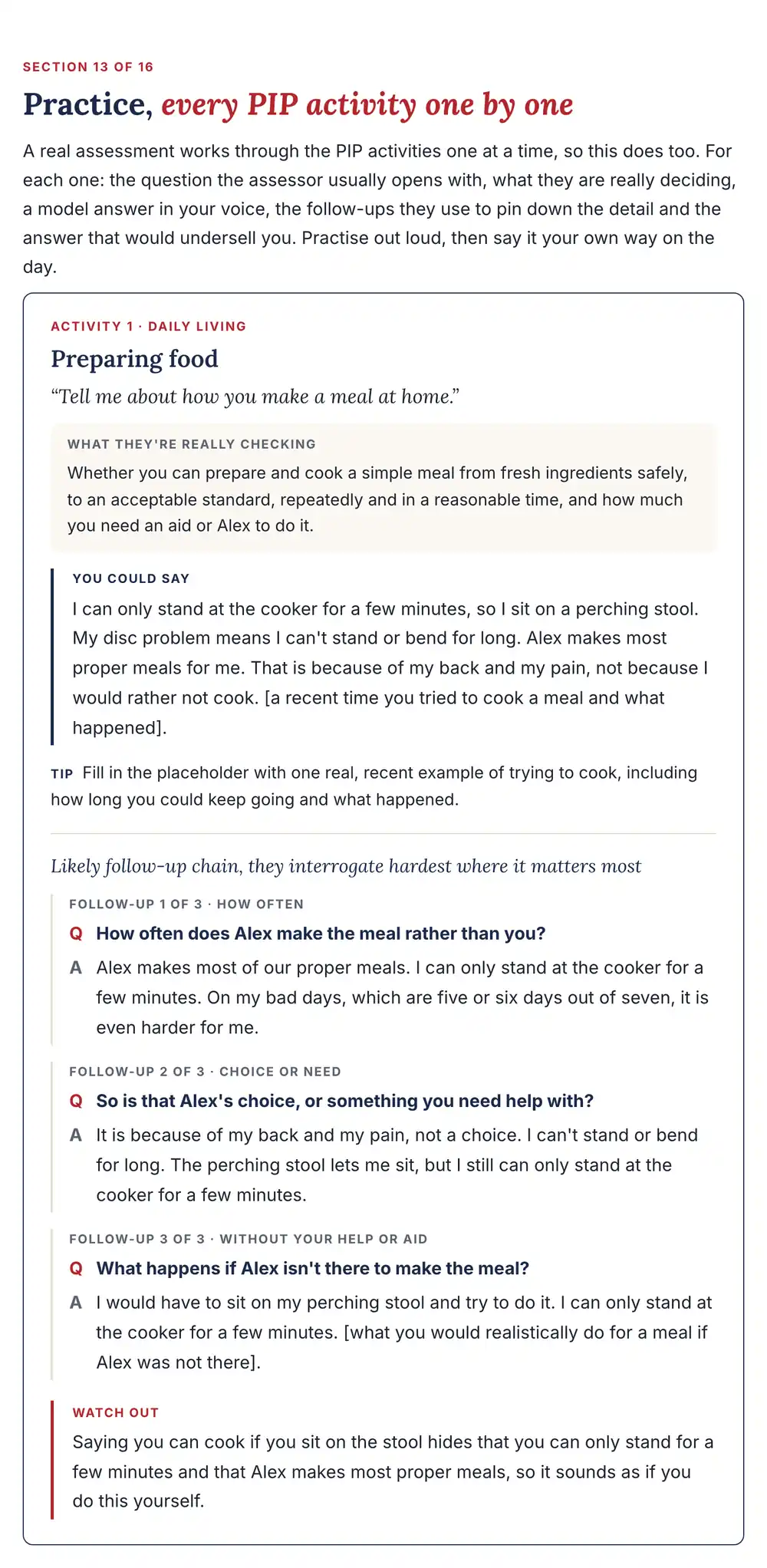
Where Sam's details did not say enough, the model answer leaves a short gap in square brackets, such as "[a recent time you tried to cook a meal and what happened]", and the tip asks for it in Sam's own words, so the answer stays Sam's. The follow-ups go deepest where the conditions bite: how long, choice or need and what happens without the help. The questions themselves are the ones covered in PIP assessment questions and answers.
Questions that sound like small talk
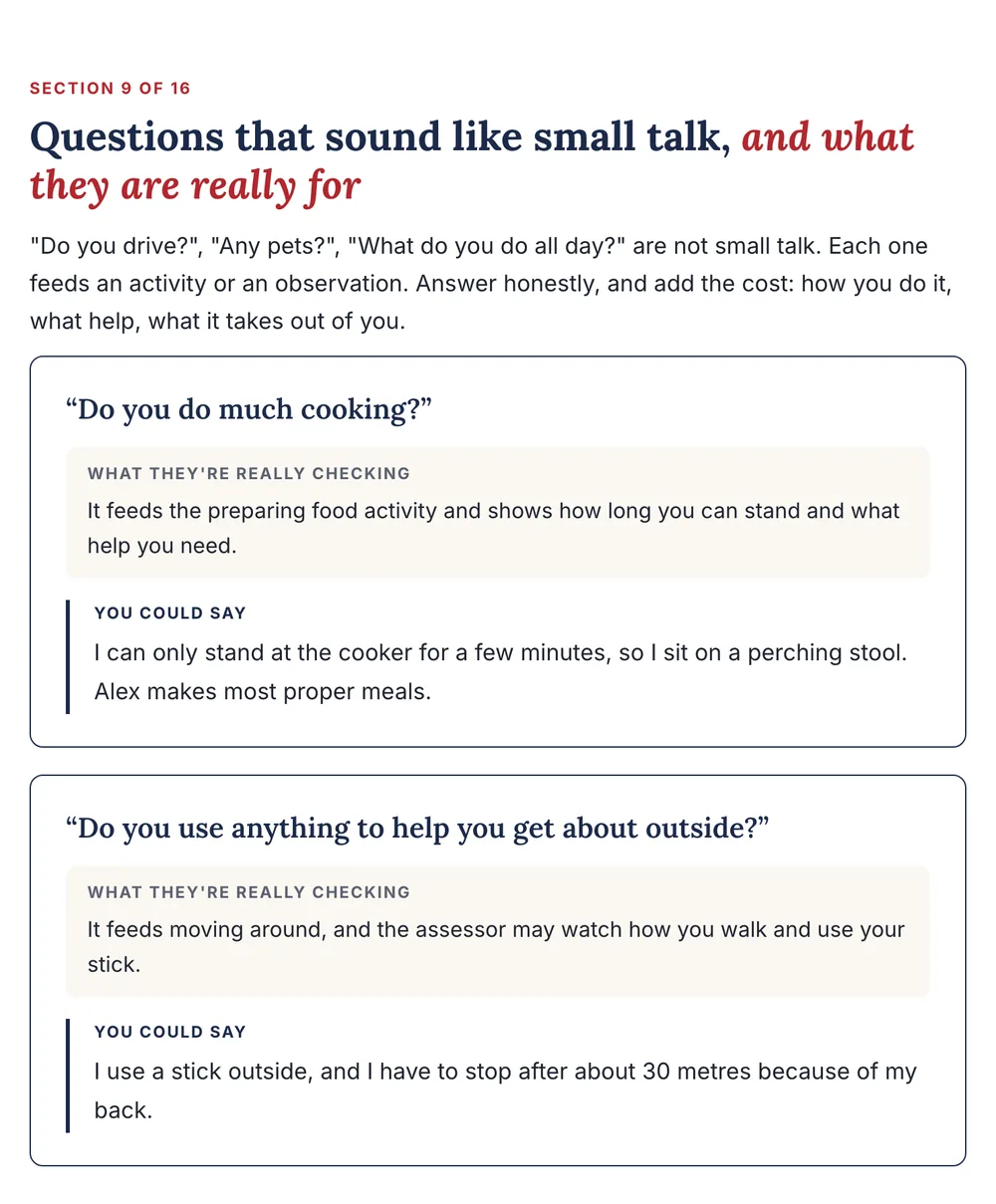
"Do you drive?", "Any pets?" and "What do you do all day?" each feed an activity or an observation. Section 9 lists the ones that fit your details, what each is checking and an answer that adds the cost: how you do it, what help you need and what it takes out of you.
PIP assessment trick questions explains why these are asked.
The one-page cheat card
The cheat card is the second PDF: one page to keep in front of you. It holds power words to use, openers to read out if you freeze, the points to hit for each topic, your aids and medication, your numbers and what never to say.
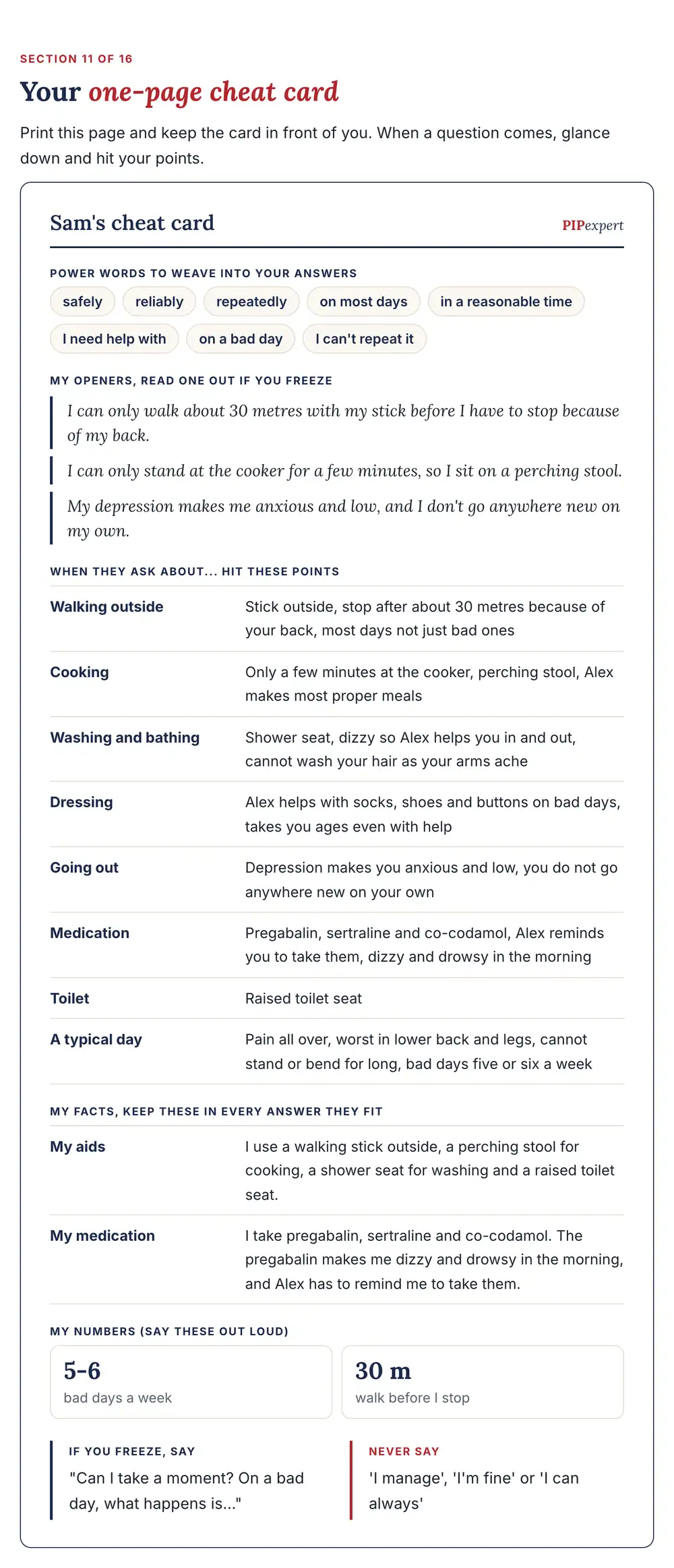
Below the points come Sam's facts (aids and medication), the numbers to say out loud (5 to 6 bad days a week, about 30 metres before stopping), a line to use if you freeze and the phrases never to say: "I manage", "I'm fine" or "I can always". Every line holds only what Sam told us, with no gaps to fill in. For more on that last list, see what not to say at a PIP assessment.
Practice mode: rehearse out loud
Practice mode gives you each question on its own, reads it aloud if you want and checks whether your answer says how often, what help you need, how safely you manage and what goes wrong, before it shows the model answer. Sam's prep had 52 questions, with a shorter round of core questions for a quick session. The prep suggests ten minutes a day until the assessment.
Your closing statement and the consistency checks
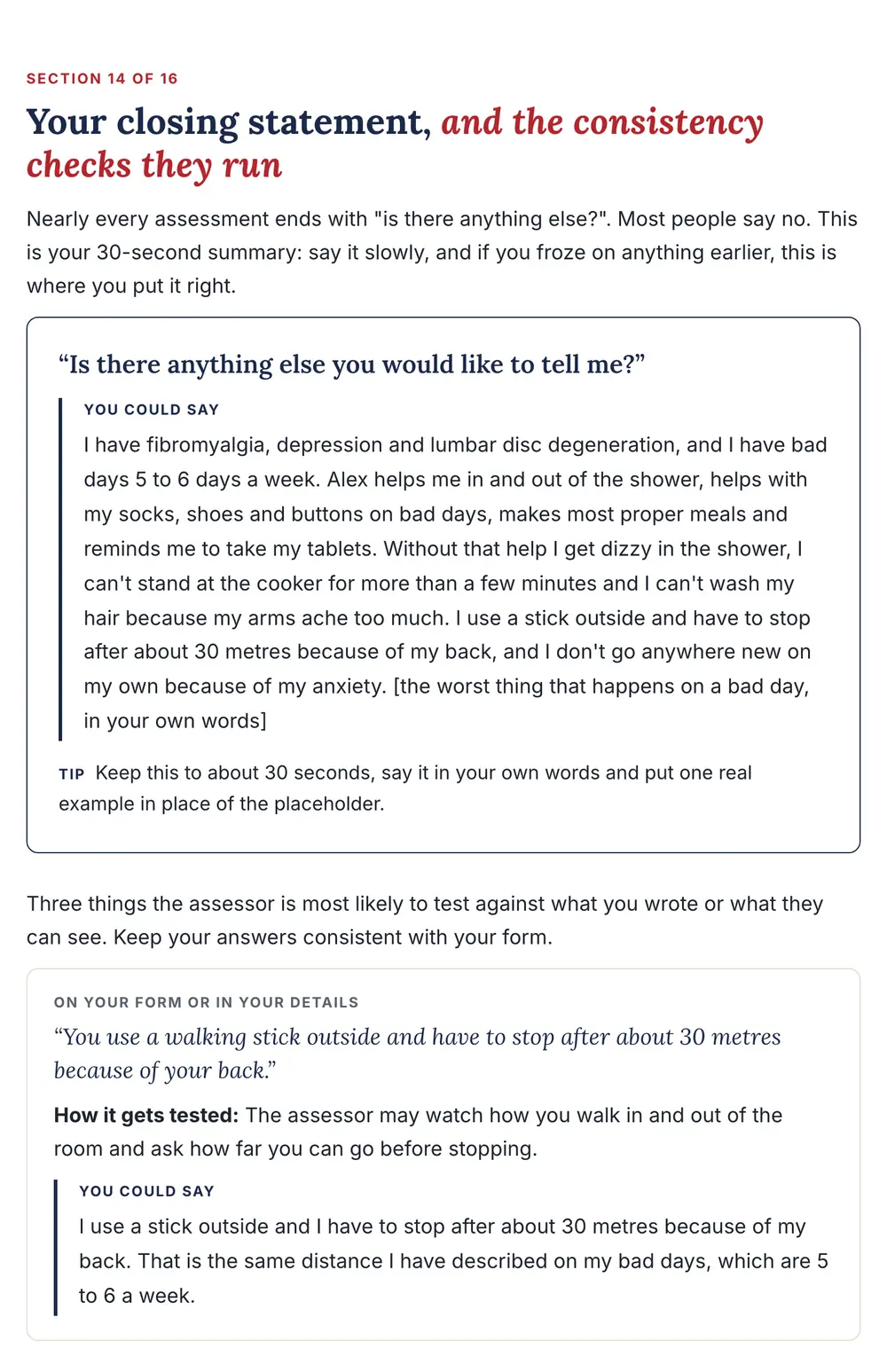
Nearly every assessment ends with "is there anything else?". Section 14 gives a 30-second summary to say slowly, then the three things the assessor is most likely to test against your form or what they can see, each with how it gets tested and what to say.
Activities you didn't mention
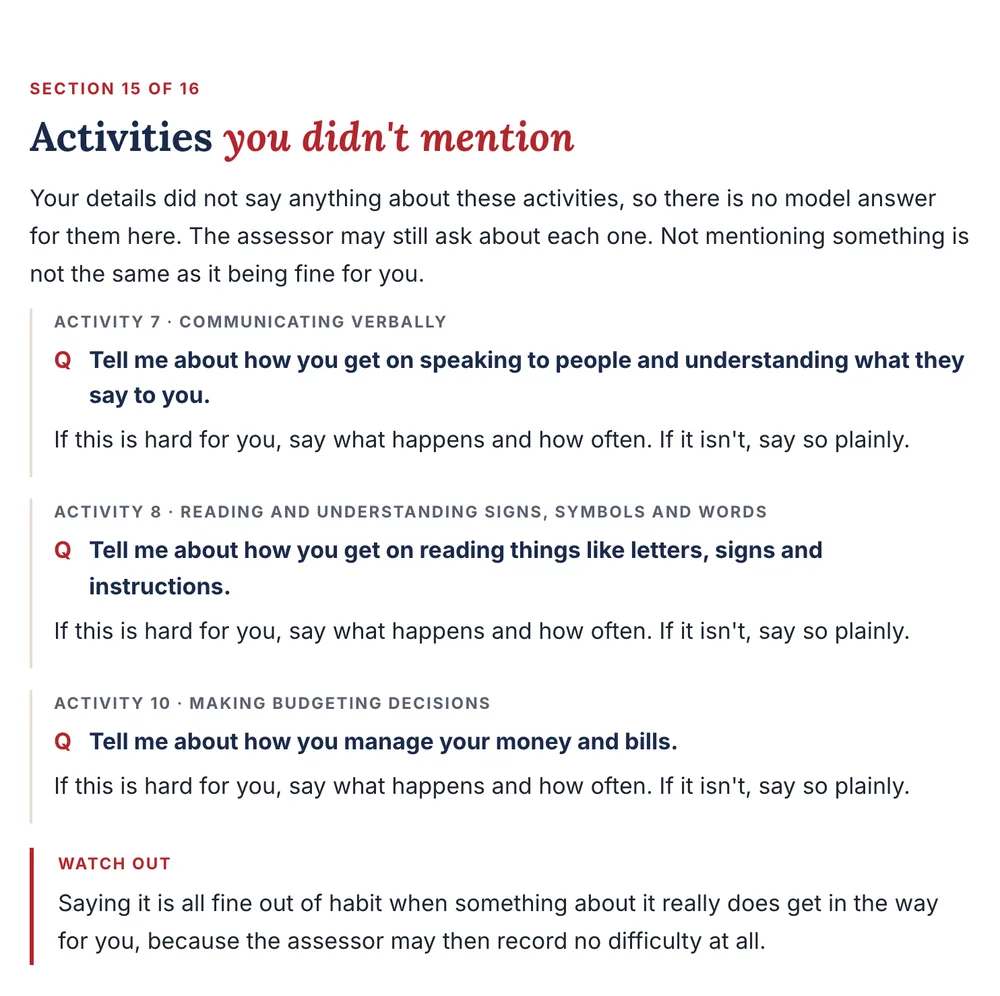
If your details say nothing about an activity, the prep does not invent an answer. Those activities are grouped in section 15, each with the question the assessor may still ask and one plain line: if this is hard for you, say what happens and how often; if it isn't, say so plainly.
The rest of the prep
- Who assesses you and what to expect for your format.
- The golden rule on good and bad days, and why "never" and "always" can cost points.
- The first ten minutes: your history, medication and what has changed, with model answers.
- Things you must remember to mention and traps to avoid.
- Informal observations: what the assessor watches the whole time.
- The physical examination, if yours is face to face.
- An on-the-day checklist and what happens after your assessment.
- Calendar reminders: give your date and download two, the evening before and the morning of.
For the assessment itself, the full guide is PIP assessment 2026: what happens, and phone assessments have their own page: the PIP phone assessment.
How it fits with Done For You
Done For You writes your answers for the PIP2 form and includes three assessment questions per activity and a one-page cheat sheet. Assessment Prep goes further on the spoken part: follow-up chains, small-talk questions, the closing statement, practice mode and your own printable cheat card. If you built your form answers with PIPexpert on the same device, the prep offers to use them so the two agree.
What Assessment Prep cannot do
- It cannot promise an outcome. The DWP makes the decision.
- It does not tell you to exaggerate. Assessors are trained to spot rehearsed or exaggerated answers, and inconsistency harms a claim. The model answers use only what you told it, and every line is yours to change.
- It works from your details. Where they are thin, you get gaps to fill in your own words.
- It is guidance, not legal or medical advice.
Not filled in your PIP form yet? The free preview writes one form answer for your conditions first.
Assessment booked?
See your first two assessment questions free, for one activity you pick. The full prep is £39.99, one-off, and ready in about a minute.
Frequently Asked Questions
What questions does the PIP assessment ask?
The assessor asks about your conditions, treatment and medication, a typical day and each of the 12 PIP activities, with follow-up questions on how often, what help you need and whether you can do things safely and repeatedly. Assessment Prep builds these for your own conditions, with model answers in your voice.
How do I prepare for a PIP assessment?
Re-read your form, practise saying what happens on most days and on bad days out loud and keep your answers consistent with what you wrote. Our guide to the PIP assessment covers the whole day, and Assessment Prep turns it into practice for your own details.
Does it cover phone and video assessments?
Yes. You tick phone, video or face to face, or all three if you are not sure, and the prep emphasises what matters for that format, such as voice pacing on the phone or the physical examination face to face.
What should I not say at a PIP assessment?
Avoid phrases that undersell you, such as "I manage", "I'm fine" or "I can do it", and avoid "never" or "always" unless they are true. Say how often, what help you need and what happens on a bad day. The cheat card lists your own never-say phrases.
Does it work for a PIP review assessment?
Yes. If you say it is a review, the prep includes how to answer the "what has changed?" question honestly.
Can I try it free?
Yes. You can see your first two assessment questions free for one activity you pick, with no card details. The full prep is £39.99.
Will the answers match my PIP form?
That is the aim. If you built your form answers with PIPexpert on the same device, the prep offers to use them; otherwise you can paste the key points of your form into the optional box, and the spoken answers are written to agree with it.
Published: .