The MR Pack is PIPexpert's help with a PIP mandatory reconsideration: for £149.99 you enter what your decision letter says, activity by activity, and our system answers each reason point by point, writes your grounds and a pre-filled reconsideration letter, lists the evidence still missing and adds tribunal papers in case the reconsideration fails. The screenshots below are one real MR Pack, section by section, made for an example claimant called Mark, whose details are made up.
Prefer to watch? The full demo is here.
- Price
- £149.99, a one-off payment.
- What you need
- Your conditions and, for the point-by-point challenge, your decision letter or assessment report to hand. Without the letter you still get everything else.
- For the reconsideration
- A point-by-point challenge of your decision, a pre-filled Mandatory Reconsideration letter, an evidence gap finder and the full Done For You report for all 12 activities.
- If the reconsideration fails
- A pre-filled witness statement, an appeal submission letter, a skeleton argument, a hearing day walkthrough and a hearing day checklist.
- Already appealing?
- Choose "Tribunal appeal" in the form and the pack is written for the tribunal stage.
- What it is not
- A guarantee, or a representative who sends anything for you. The DWP, or a tribunal, decides.
What you enter: your decision, activity by activity
With your decision letter (or the PA4 assessment report, if you have it) next to you, you pick the descriptor the DWP gave you for each activity and copy or summarise what they wrote. You skip any activity you agree with, and if you are not sure what they scored, you leave "Not sure" and describe what they said.
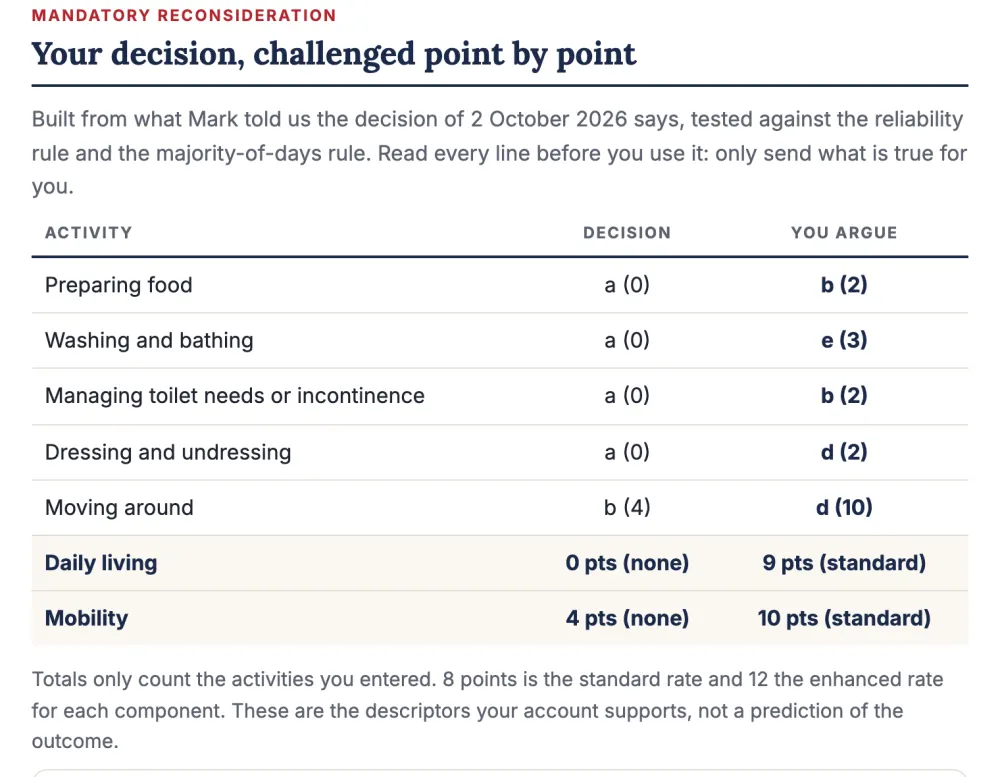
The rest of the form is the same as for Done For You: your conditions, how they affect you, bad days, medication, aids and who you live with. Mark entered osteoarthritis in both knees and COPD, co-codamol (which makes him drowsy) and a salbutamol inhaler, a walking stick, a perching stool, a bath board and a raised toilet seat, and that his partner helps him. His decision, dated 2 October 2026, gave him 0 points for daily living and 4 for mobility. He challenged five activities.
If you live in Northern Ireland, PIP is run by the Department for Communities, and the pack uses the Northern Ireland regulations of 2016 and names the Appeals Service at the appeal stage. In Scotland, new claims are for Adult Disability Payment, which has its own way to challenge a decision, covered on our sister site ADPexpert.
What arrives: two parts, two PDFs and an email copy
The pack opens on screen in two parts. Part 1 challenges your decision: your grounds activity by activity, your letter and what to do next. Part 2 has the full Done For You report with written answers, the evidence plan and the tribunal materials.
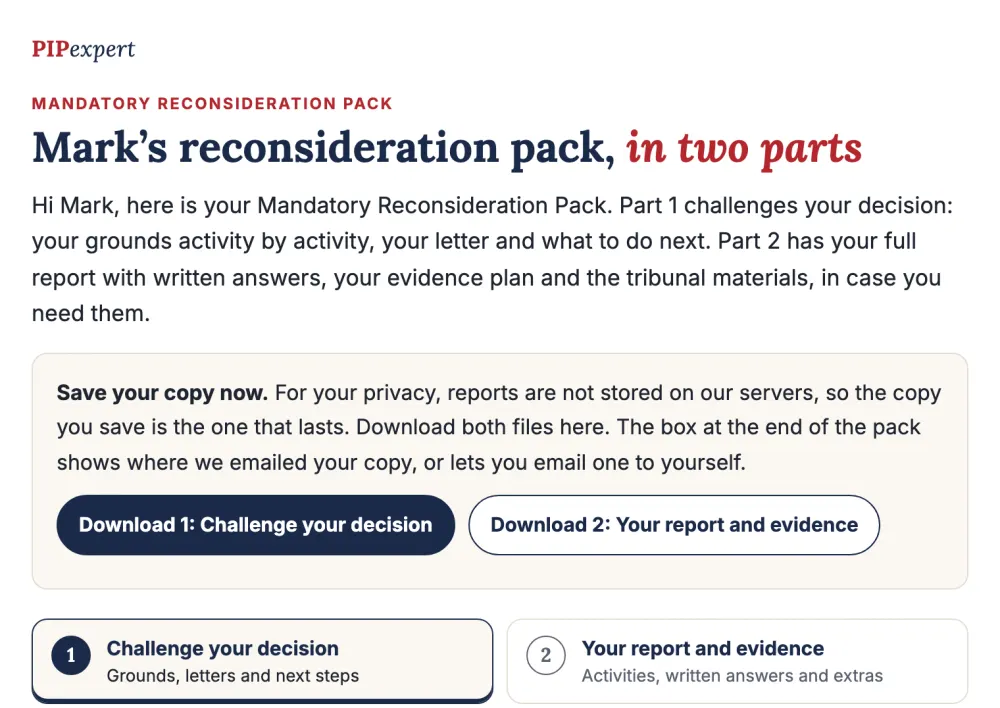
As with every PIPexpert report, nothing is stored on our servers, so download both files and keep the email copy.
Your decision, challenged point by point
Part 1 starts with a table: each activity you challenged, the descriptor and points the DWP gave and the descriptor your account supports. The totals show what that would mean for each component. The note under the table says what it is: the descriptors your account supports, not a prediction of the outcome.
One activity in detail: the challenge card
Each activity you challenged gets a card with four parts: what the decision relied on, why it does not hold, the evidence to point to and a paragraph of grounds to paste. Here is Mark's first one, preparing food:
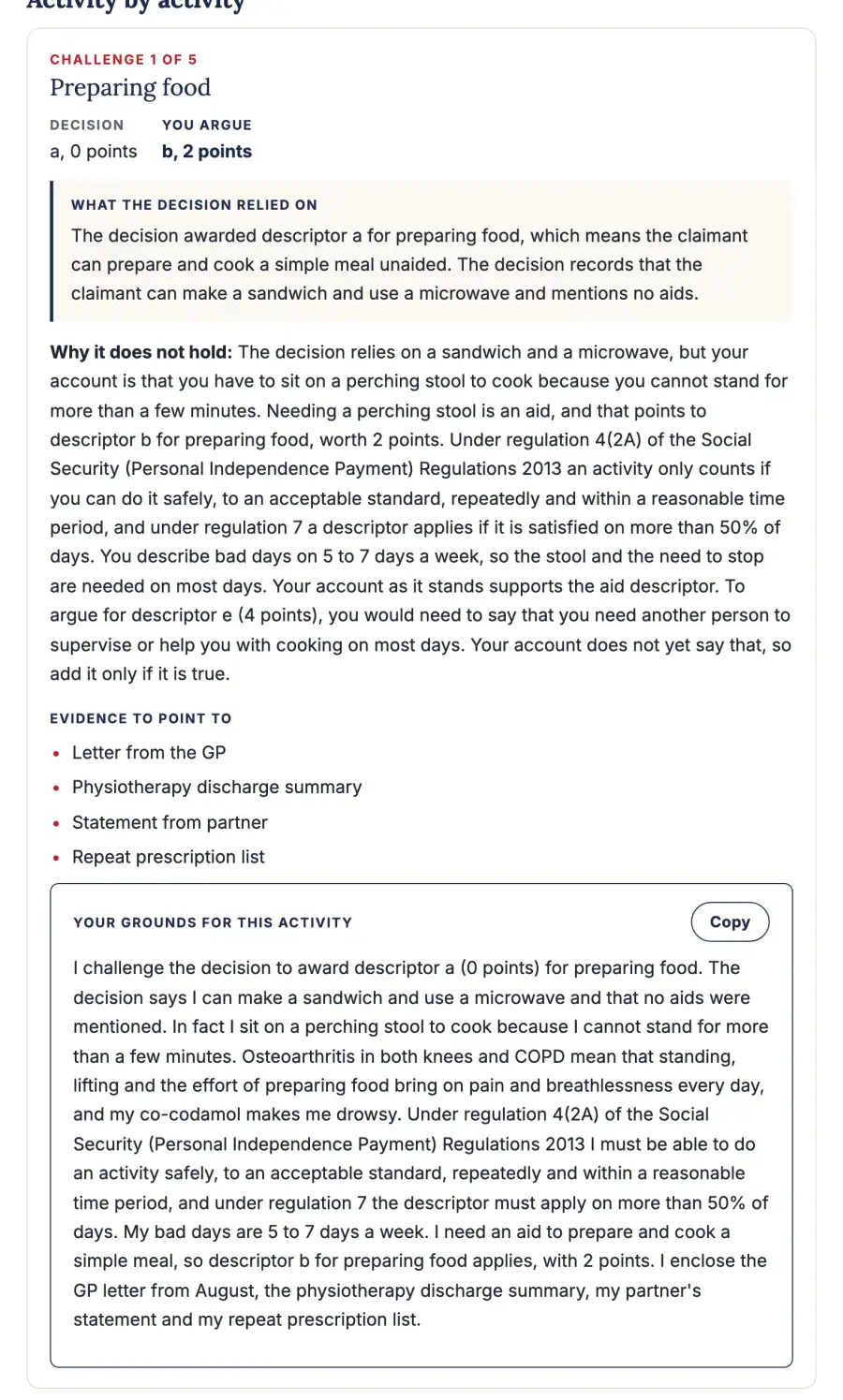
Two things stand out. The grounds answer what the decision said (a sandwich and a microwave) with what Mark told the form (a perching stool, pain and breathlessness on 5 to 7 days a week). And the card argues only for what his account supports: it explains what descriptor e would need and tells him to add it "only if it is true". The law it cites is regulation 4(2A) of the PIP Regulations 2013 (safely, to an acceptable standard, repeatedly and within a reasonable time period) and regulation 7 (a descriptor applies when it is met on over 50% of the days).
Before the cards, Part 1 also has a short opening statement to copy and a section called "What the assessor relied on, answered", which replies to the general reasons a decision gives, such as what was observed at the assessment or that medication controls a condition.
Your Mandatory Reconsideration letter, written for you
The letter brings the grounds together: which decision you are challenging, your conditions and aids, the descriptor you ask for in each activity with the points, the two regulations and the evidence you enclose. It also corrects a factual error Mark entered: his assessment report says he came alone, but his partner drove him there and waited in the car.
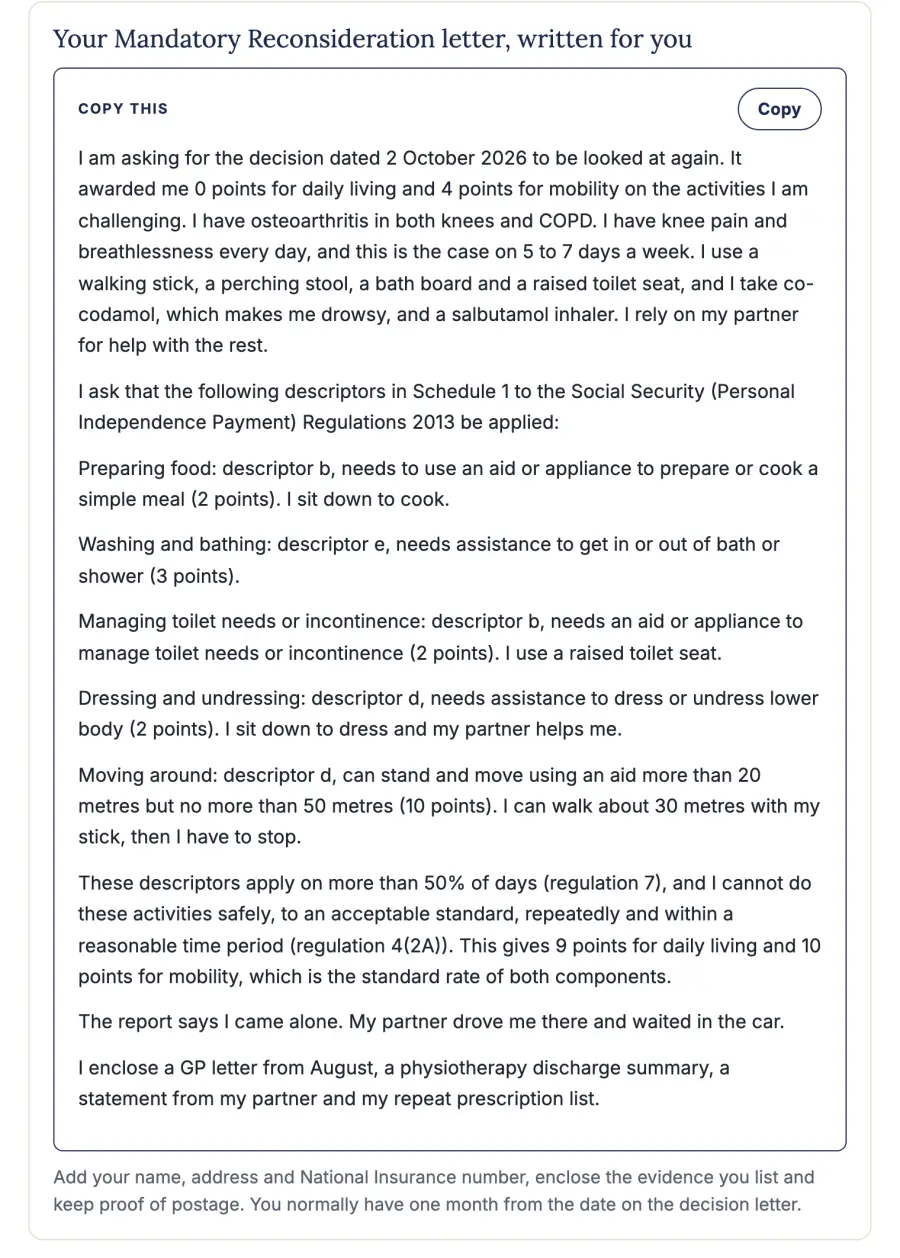
You add your name, address and National Insurance number, which are among the details GOV.UK asks for, and send it to the contact details on your decision letter. If you would rather use the official form, the pack has a button that opens the CRMR1 with your grounds already in question 17; you send either the form or the letter, not both. Our free CRMR1 filler explains the form.
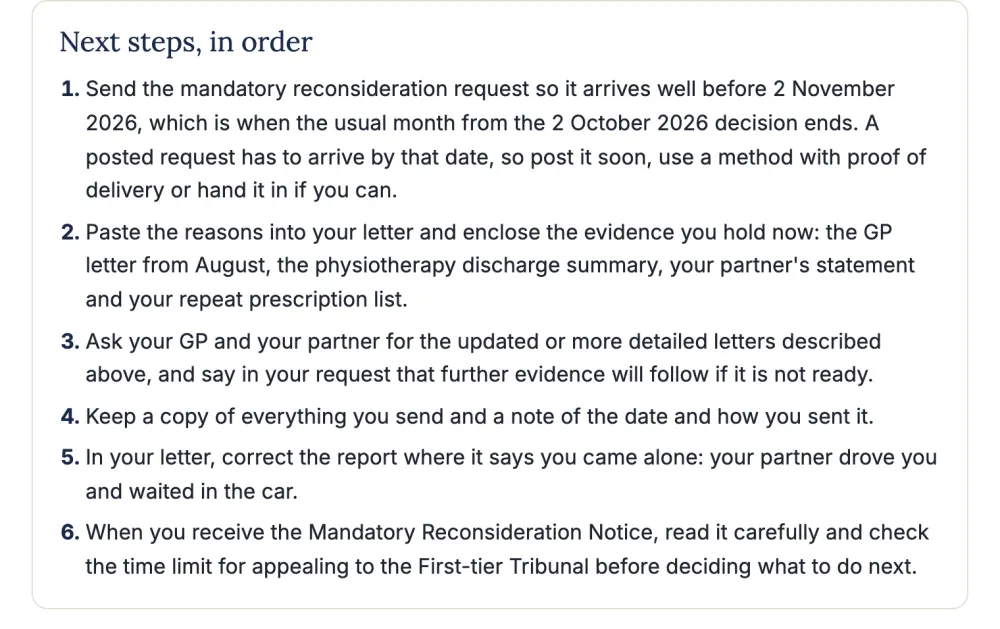
Next steps, in order, with your own deadline
The next steps are worked out from your decision date. For Mark's decision of 2 October 2026, step 1 says the request has to arrive well before 2 November 2026.
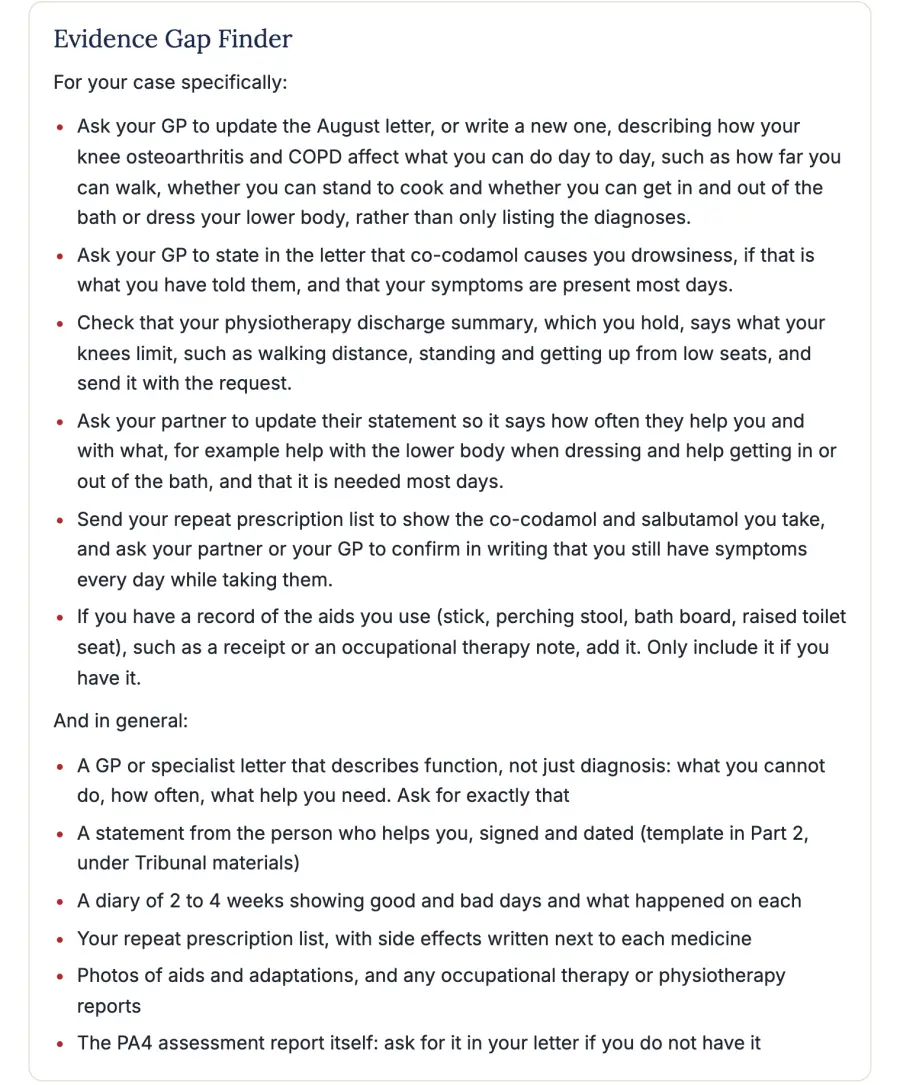
The Evidence Gap Finder
The Evidence Gap Finder lists the evidence that would back the grounds, starting with what this claimant could ask for and then a general list. It names what to ask each person for, so a GP letter describes what you cannot do rather than only listing diagnoses.
For what makes evidence useful, see the PIP evidence checklist.
If the reconsideration fails: the tribunal materials
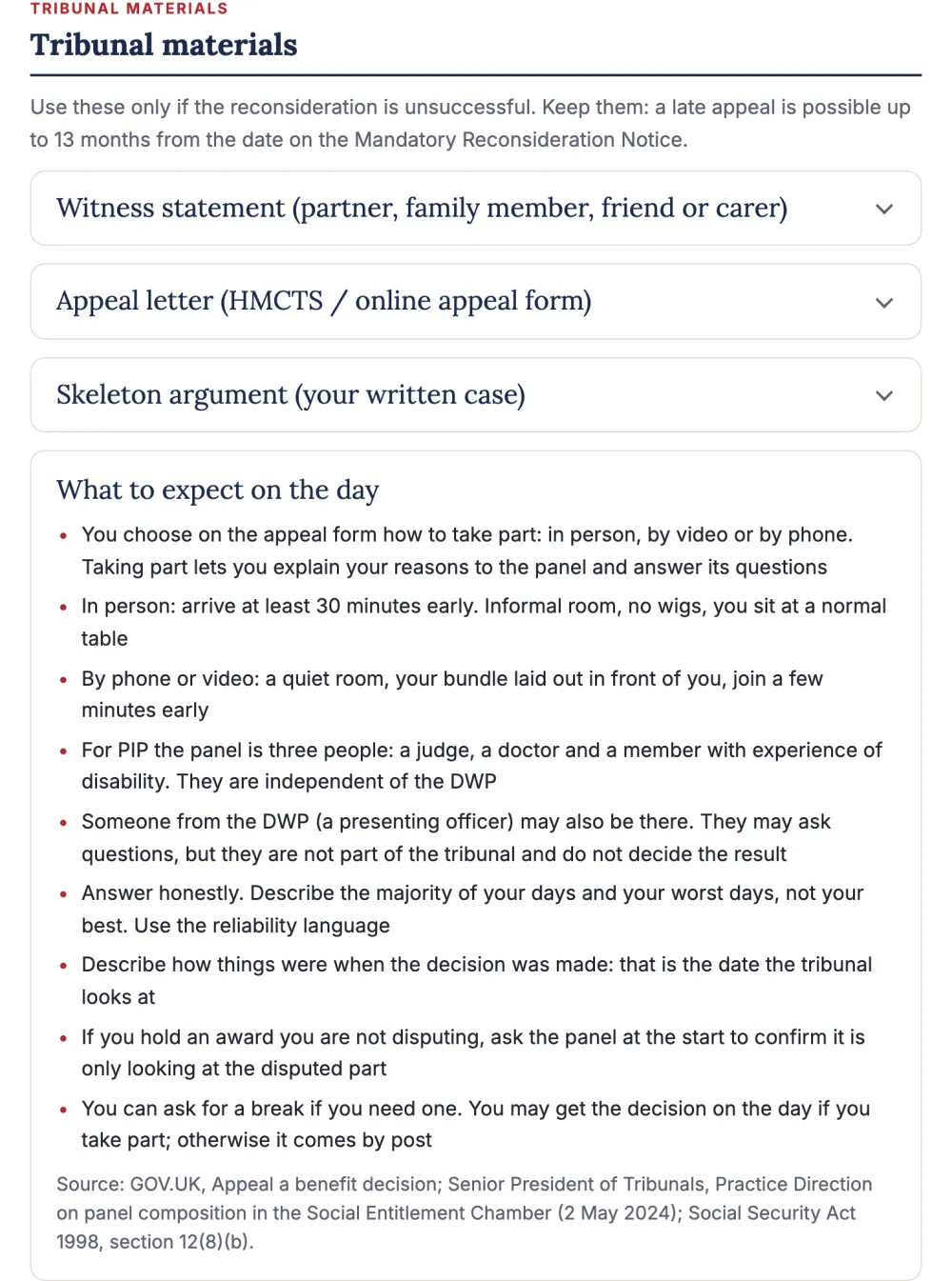
A refused reconsideration is followed by a mandatory reconsideration notice, and that notice is what lets you appeal. GOV.UK says to appeal within one month of getting your mandatory reconsideration decision; if you start after a month you have to explain why, and your appeal might not be accepted. You can appeal online or by post on form SSCS1.
Part 2 holds the papers for that stage, so you already have them if you need them: a witness statement for a partner, family member, friend or carer, an appeal letter, a skeleton argument (your written case), what to expect on the day and a hearing day checklist.
Our PIP tribunal guide covers the hearing itself.
Part 2: the full Done For You report
The MR Pack includes the full Done For You report for all 12 activities: written answers, the assessment questions with model answers, the evidence plan, the assessment call cheat sheet, the GP letter template and the rest. If your claim is looked at again or goes to a hearing, those answers keep what you say consistent with your grounds. What a Done For You report looks like shows each part.
What the MR Pack cannot do
- It cannot promise a changed decision. The DWP decides the reconsideration and a tribunal decides an appeal. No service can promise an award.
- It does not send anything for you. You check the grounds, add your details and send the letter or the CRMR1 yourself, on time.
- It only argues what you tell it. Every line is yours to check. Delete anything that is not true for you before you send it.
- It is guidance, not legal advice. A welfare rights adviser or Citizens Advice can help for free, and can represent you at a tribunal.
Free first steps
Two free tools come before the pack: the Decision Analyser checks the scores in your decision letter and shows where you may score higher, and the free MR letter tool writes an activity-by-activity reconsideration letter. If you have not claimed yet, the free preview writes one PIP form answer for your conditions. The full guide to the process is PIP mandatory reconsideration, step by step.
Challenging a PIP decision?
- Check your decision free: enter the scores from your decision letter and see which activities may be worth challenging.
- Write your MR letter free: an activity-by-activity Mandatory Reconsideration letter built around the reliability test.
- Or get the full MR Pack · £149.99: a point-by-point challenge of your decision letter, a pre-filled MR letter and tribunal papers if the MR fails.
Frequently Asked Questions
Where can I get help with a PIP mandatory reconsideration?
Free help is available from Citizens Advice and local welfare rights services, and our free Decision Analyser and MR letter tool help you write the request yourself. The MR Pack (£149.99) challenges your decision point by point and adds the full Done For You report and tribunal papers.
How do I write a mandatory reconsideration letter for PIP?
Say which decision you disagree with and its date, then for each activity say which descriptor you think applies and why, using what happens on most days and whether you can do the activity safely, to an acceptable standard, repeatedly and in a reasonable time. Add your name, address, date of birth and National Insurance number, and list any evidence you enclose.
Is there a PIP mandatory reconsideration letter example?
This page shows a full letter written for an example claimant. Our free MR letter tool builds one for your own decision, activity by activity.
What is the deadline for a PIP mandatory reconsideration?
GOV.UK says you usually need to ask within one month of the date on your decision letter, and a posted letter or form must arrive by then. You can ask later with a good reason, such as a stay in hospital or a bereavement, and you must explain why it is late.
Where do I send my mandatory reconsideration letter for PIP?
To the office that made the decision, using the contact details on your decision letter. GOV.UK says you can ask by phone, by letter or on the CRMR1 form, and if you do not have the letter you contact the office where you applied.
Can I use the MR Pack if I am already appealing to a tribunal?
Yes. Choose "Tribunal appeal" in the form and the pack is written for the tribunal stage, with the witness statement, appeal letter, skeleton argument and hearing day materials.
Does the MR Pack guarantee my decision will change?
No. The DWP decides the reconsideration and a tribunal decides an appeal. The pack helps you answer each reason in the decision with your own facts and the rules the decision is made under.
Published: .