Can you get WaterSure on PIP? Not on PIP alone, for now. Today the WaterSure scheme needs a water meter and a means-tested benefit such as Universal Credit, Pension Credit or Housing Benefit. You also need high water use because of a medical condition or three or more children. If you get PIP and one of those benefits, you may already qualify.
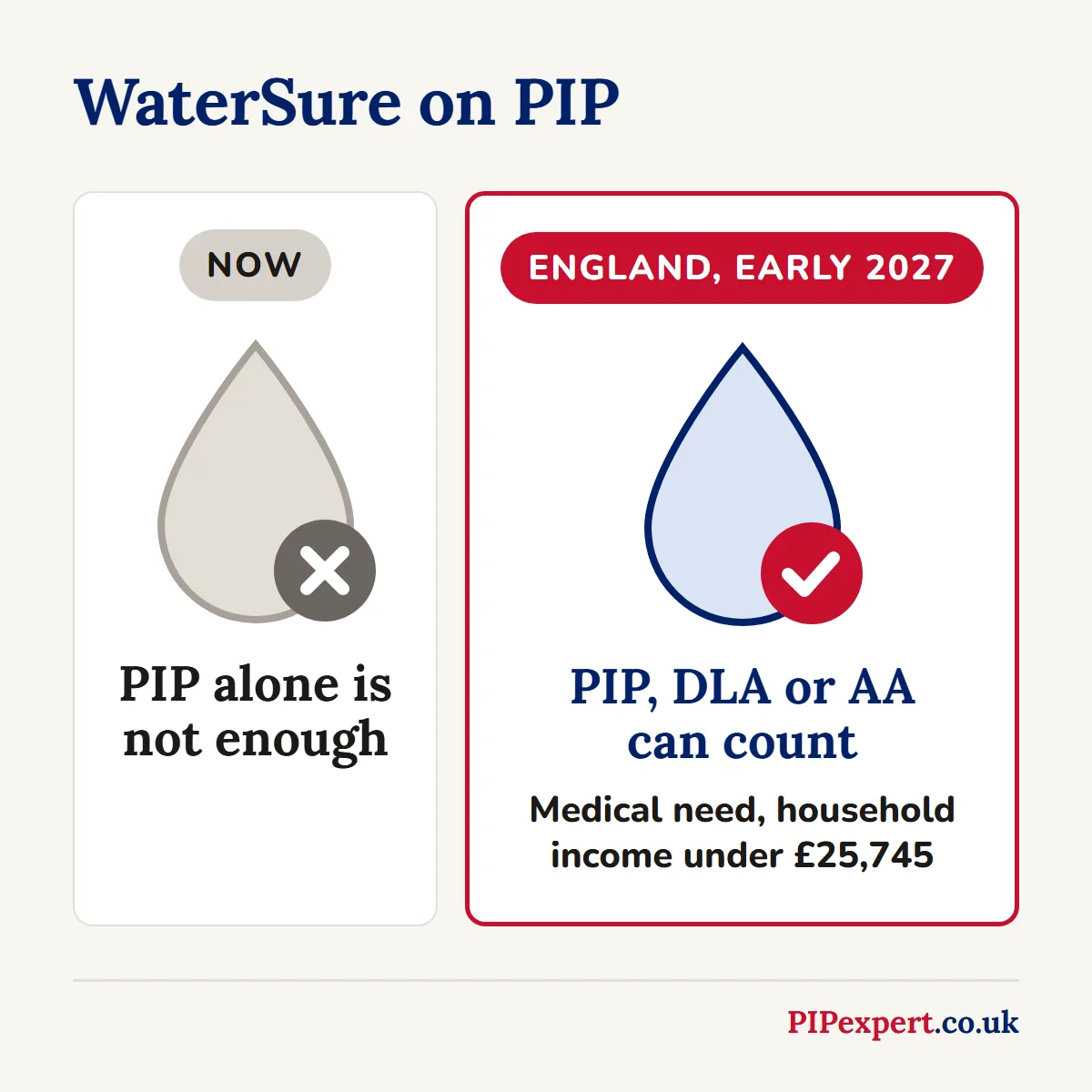
That is about to change in England. The government has said PIP, Disability Living Allowance and Attendance Allowance will be added to the list of qualifying benefits for people who need extra water for a medical reason, with a household income limit of £25,745 a year. The changes are set to come into force in early 2027. On 27 November 2026 it also said water companies will use DWP data to contact up to 250,000 more households who are missing out.
WaterSure at a glance (checked at official sources, 28 November 2026):
- What it does: caps a metered water bill at your water company's average household bill.
- Average saving: £325 in 2024/25, on bills that averaged around £890 before the cap.
- Who gets it now: about 260,000 households in 2024/25 (around 300,000 now, the government said on 27 November 2026), and fewer than half of eligible households claim.
- Set for early 2027 (England): PIP, DLA and Attendance Allowance count, with an income limit of £25,745 and no doctor's note.
Struggling to put your difficulties into words?
PIPexpert turns how your condition affects you into the detailed answers the PIP2 form actually asks for. See it work on one activity, completely free.
Try one activity free →What is the WaterSure scheme?
WaterSure is a scheme that water companies in England must offer to low-income households with high essential water use. It started in 1999, and the current rules are the Water Industry (Charges) (Vulnerable Groups) (Consolidation) Regulations 2015. In Wales water companies offer it voluntarily. It covers England and Wales only, so it does not apply in Scotland or Northern Ireland.
If you qualify, your bill is based on your company's average household charge for water and sewerage, and at the end of the period it is adjusted so you never pay more than you would have paid without WaterSure. In other words, the cap can only lower your bill. Entitlement lasts 12 months from when you apply (or to the end of that billing period), so you need to renew it every year.
The savings are real. The government says around 260,000 households got a WaterSure discount in 2024/25, about 230,000 in England and 30,000 in Wales. Their bills averaged around £890 before the cap, and the average saving was £325, over a third of a typical bill. For comparison, the average household water bill was £603 in 2025/26 and is forecast at £639 for 2026/27.
Who qualifies for WaterSure now?
Under the 2015 regulations you need all three of these.
1. A water meter
Your charges must be based on how much water you use. If you are waiting for a meter, you can still apply, and if one cannot be fitted you must be paying an assessed charge instead. You can ask your water company for a meter, and the new Water Charter for England says it must normally fit one free of charge within 8 weeks, unless that is not practical or would cost too much. If you switch to a meter, you can usually switch back to unmetered charges within 2 years, unless you live in an area with compulsory metering.
2. High water use for one of two reasons
- Three or more children: someone in the home gets Child Benefit for three or more children under 19 who live with you.
- A medical condition: someone in the home has a condition that means they have to use a significant extra amount of water.
The regulations name seven conditions: desquamation (flaky skin), weeping skin disease, incontinence, an abdominal stoma, Crohn's disease, ulcerative colitis and kidney failure needing dialysis at home. Home dialysis does not count if the health authority already pays towards the water used for it. Other conditions can count too, as long as they mean you have to use a lot more water, but for those the company can currently ask for a signed certificate from a doctor.
3. A qualifying benefit
Someone in the home must be entitled to one of these:
- Universal Credit
- Pension Credit
- Housing Benefit
- Income Support
- income-based Jobseeker's Allowance
- income-related Employment and Support Allowance
- Working Tax Credit, or Child Tax Credit that includes the individual element
There are a few exclusions. WaterSure is for your only or main home, and you cannot get it if you water the garden with a sprinkler or other apparatus (watering by hand is fine) or automatically refill a pond or swimming pool that holds more than 10,000 litres.
Can you get WaterSure on PIP today?
Not on PIP by itself. PIP, DLA and Attendance Allowance are not on the current list of qualifying benefits, because they are not means-tested. So someone with Crohn's disease who gets PIP but no means-tested benefit does not qualify under the rules as they stand, however much water they use.
Some people on PIP do get one of the qualifying benefits, though. If you get PIP and Universal Credit, Pension Credit, Housing Benefit or income-related ESA (see PIP and ESA), and you have a water meter and a medical reason for high water use, you may be able to apply now. New Style ESA on its own is not on the list.
It is also worth asking your own water company. The government's consultation response notes that some companies run an enhanced version, often called WaterSure Plus, which can go beyond the legal minimum with wider eligibility or bigger reductions. What each company offers varies, so check its website or ask what support it has for disabled customers.
What changes in early 2027
On 6 March 2026 the government announced what it called the first changes to WaterSure since 1999, after a Defra consultation that ran from July to September 2025 and drew 63 responses. These are the changes it has confirmed.
PIP, DLA and Attendance Allowance will count
For the first time, Disability Living Allowance, Attendance Allowance and PIP will be on the legal list of qualifying benefits. You will still need to be a high water user for a medical reason, so the three children route still needs a means-tested benefit. The government expects this to bring around 53,000 more households into the scheme.
A household income limit of £25,745
If you qualify through a disability benefit, your household income must be below £25,745 a year. Defra first proposed 60% of median income, but many responses said that was too low, so it is mirroring the award of a couple on Universal Credit where a disability is present.
The consultation response also says the income threshold will leave out non-means-tested disability benefits such as PIP. Respondents pointed out that PIP is meant for wider disability costs, not high water bills, and that counting it would make applying harder. Our reading is that your PIP should not push your household over the £25,745 limit.
Fairer caps
- The lower average: companies will have to cap bills at whichever is lower, the average bill for all customers or the average metered bill. At the moment they work this out in different ways.
- People living alone: bills will be capped at the average bill for a one-person household. The government estimates 53,000 single households will save an extra £100 a year, and around 130,000 larger households an extra £26 on average.
No doctor's note
You will no longer need to pay for a doctor's note to show you have a medical condition. The government says water companies have agreed to do this voluntarily. It did not add more named conditions to the list, because it could not find enough evidence about which ones always lead to high water use. Instead it will issue guidance asking companies to use inclusive wording, so people with conditions that are not named do not rule themselves out.
When it starts and where
The government says the reforms are set to come into force in early 2027 and will be funded by an extra £1.14 on other customers' bills. They are mandatory in England and voluntary in Wales. Defra will make them through new regulations, and when we checked legislation.gov.uk on 28 November 2026 the amending regulations had not yet been made. Until they are, the current rules above apply.
Will your water company contact you?
Possibly. On 27 November 2026 the government said water companies will use data from the Department for Work and Pensions to identify and contact up to 250,000 more households who could get WaterSure but are not claiming it. It named families with three or more children under 19 and people with medical conditions that need more water use. The government puts the saving for those households at £428 a year, and says fewer than half of eligible households currently claim, often because they do not know about it or have to prove eligibility themselves.
Its response to the consultation also says the amended regulations will remove the requirement for customers to submit an application. That is not in force yet, so if you think you qualify now, do not wait for a letter: apply to your water company. If you get a call, text or email about WaterSure and are unsure it is genuine, contact your water company on the number printed on your bill before sharing any details.
The same announcement said the Consumer Council for Water will become a stronger Water Watchdog, and a Water Charter setting out your rights as a customer was published on GOV.UK.
How to apply for WaterSure
- Find your water company. Apply to the company that supplies your water; it passes your details to your sewerage company if that is a different one.
- Get a meter if you do not have one. Ask for it at the same time; you can apply while you wait.
- Gather proof of your benefit. The company can refuse an application without a copy of your latest award notice, dated within the last 12 months for benefits or 6 months for tax credits.
- Describe the medical need. For a listed condition, the company can ask for information on the condition and how it increases your water use. For another condition, it can currently ask for a doctor's certificate, although the government says companies have agreed to drop medical notes.
- Put a date in your diary. Entitlement lasts about 12 months, so reapply each year.
If you are behind on your water bill, the Water Charter for England is clear that your company cannot disconnect your supply for non-payment, and it must give you a chance to agree new payment arrangements before taking you to court or reporting the debt to a credit reference agency. Companies also run social tariffs, payment breaks and instalment plans, and if you are disabled or ill you can join your company's Priority Services Register for extra help, such as priority bottled water during an interruption and bills in other formats. If a complaint is not resolved, you can take it to the Consumer Council for Water.
Water use and your PIP claim
The conditions that qualify for WaterSure often affect daily life in ways PIP assesses. Washing often, managing a stoma or continence needs and changing clothes or bedding are the kind of daily tasks covered by Activity 4, washing and bathing and Activity 5, managing toilet needs. If you claim PIP for a condition like Crohn's disease or colitis, a stoma, incontinence, kidney disease or a severe skin condition, describing these daily tasks in detail on your form can help the assessor understand your needs. A PIP award does not depend on WaterSure, and WaterSure does not depend on your PIP points, but the same evidence about your day is often useful for both.
If the changes start as planned in early 2027, a PIP award in England may itself open the door to WaterSure, as long as you also have the medical need and your household income is under £25,745. The same goes for a child on DLA or a pensioner on Attendance Allowance. For other help with bills this winter, see Winter Fuel Payment and PIP and PIP and council tax, and for how PIP sits with other benefits, does PIP affect other benefits.
Frequently Asked Questions
Can you get WaterSure on PIP?
Not on PIP alone at the moment. You also need a means-tested benefit such as Universal Credit, Pension Credit or Housing Benefit, a water meter and high water use from a medical condition or three or more children. The government plans to add PIP in England in early 2027.
Who qualifies for the WaterSure scheme?
Households with a water meter (or an assessed charge) who use a lot of water because of a qualifying medical condition or three or more children under 19, where someone gets Universal Credit, Pension Credit, Housing Benefit, Income Support, income-based JSA, income-related ESA or a qualifying tax credit.
How much can WaterSure save?
It caps your bill at your water company's average household bill. The government says the average saving was £325 in 2024/25, on bills that averaged around £890 before the cap.
When will PIP count for WaterSure?
The government says the changes are set to come into force in early 2027 in England. When we checked on 28 November 2026 the amending regulations had not yet been made, so the current rules still apply.
Does PIP count as income for the £25,745 limit?
According to the government's consultation response, no. It decided to leave non-means-tested disability benefits such as PIP out of the income threshold for the new disability route, though the final regulations are not yet made.
Do I need a doctor's note for WaterSure?
Under the current rules a company can ask for a doctor's certificate for a condition that is not on the named list. The government says water companies have agreed to stop asking for medical notes, and the new rules are set to remove the need for one.
Is WaterSure available in Wales and Scotland?
In Wales water companies offer it voluntarily, and the 2027 changes are voluntary there. WaterSure covers England and Wales only, so it does not apply in Scotland or Northern Ireland.
Need help with your PIP form?
PIPexpert generates personalised PIP2 answers for all 12 activities based on your specific conditions. You can try one activity completely free to see what it produces.
Published: .