An ongoing PIP award is an award with no end date. The DWP's stated intention is a light touch review at the 10-year point, using a shorter form called the AR2. In most cases a DWP case manager completes that review without an assessment. An ongoing award is not fixed for life: you still have to report changes, and it can go up, go down or stop.
On 24 November 2026 the government accepted two proposals from the Timms Review that touch ongoing awards: no repeated award reviews for people with lifelong conditions where the evidence is clear, and a fast track without an unnecessary full assessment for people with the most serious, well-evidenced needs. Neither has a start date. Nothing changes to anyone's PIP today.
Struggling to put your difficulties into words?
PIPexpert turns how your condition affects you into the detailed answers the PIP2 form actually asks for. See it work on one activity, completely free.
Try one activity free →- No end date. The DWP intends a light touch review at the 10-year point (DWP statistics to July 2026).
- A shorter review form. That review uses the AR2, and in most cases no assessment with a health professional is needed (DWP PIP assessment guide).
- Still the exception. Around 32% of everyone on PIP had one in March 2026 (Timms Review report).
- Changes accepted, no date. Fewer reviews for lifelong conditions and a fast track were accepted on 24 November 2026, with no start date.
What Does an Ongoing PIP Award Mean?
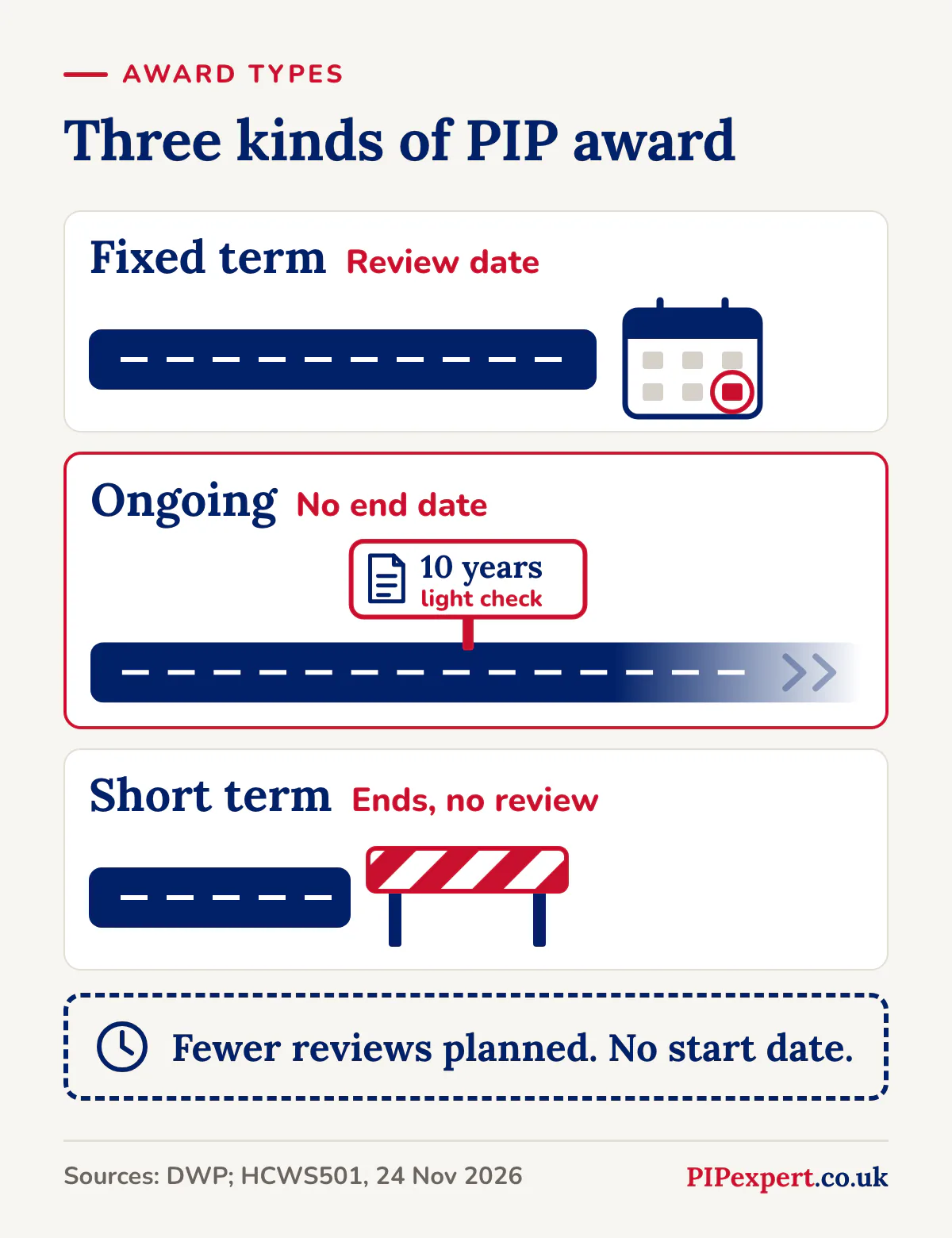
An ongoing PIP award has no end date. The DWP describes it as an award "with no end date, where the intention will be to apply a light-touch review at the 10-year point". Most PIP awards are fixed term: they end on a set date, with a review before then.
The DWP sets out three kinds of award in its PIP statistics:
| Award type | How long it lasts | What happens next |
|---|---|---|
| Fixed term (most awards) | A set period. Your decision letter gives the end date | A review, usually with the AR1 form, before the award ends |
| Ongoing | No end date | A light touch review at the 10-year point, on the shorter AR2 form |
| Short term without review | Ends within a small number of years | No review: it ends unless you make a new claim. Mostly given under Special Rules for End of Life |
The DWP says award types and review periods "are set on an individual basis, based on the claimant's needs and the likelihood of those needs changing". The law makes a fixed term the default: section 88 of the Welfare Reform Act 2012 says an award is to be for a fixed term "except where the person making the award considers that a fixed term award would be inappropriate".
Your decision letter tells you which kind you have: GOV.UK says it "will tell you when your claim will end and if it will be reviewed". For fixed-term awards, the DWP says most new awards to people aged 25 or over since April 2026 are for 4 years with a review after 3 years; our guide to how often PIP is reviewed covers those intervals.
Who Gets an Ongoing PIP Award?
You are likely to be considered for an ongoing award when your needs are unlikely to change, or are only likely to get worse. There is no list of qualifying conditions: the decision rests on how your condition affects you and on the evidence about how it is likely to develop.
The DWP's guide for assessment providers says an ongoing award is appropriate to recommend in three situations:
- the health professional sees no likely change to your functional impairment, meaning the way your condition limits what you can do
- your functional impairment is not likely to change much in the long term, "allowing for short-term periods of functional change in the case of fluctuating conditions"
- you have very high needs in both daily living and mobility, likely to reach the enhanced rate of both, and your needs are only likely to increase, such as with a progressive condition
The guide's examples of "no review" cases are an adult with a learning disability present since birth whose functional ability has not changed in years, and a man with motor neurone disease whose high needs are only likely to increase.
The final choice belongs to the DWP case manager, who the guide says "must select the most appropriate award type and duration" once the points are decided, using the health professional's advice on whether your condition is likely to improve, stay the same or worsen.
People over State Pension age
Since 31 May 2019, people whose review would have taken place when they were over State Pension age have generally been given ongoing awards with a review at the 10-year point, according to the DWP. Our guide to PIP after State Pension age explains what else changes at that age.
How many people have one
In the quarter to July 2026, 8% of normal rules new claims that were awarded got an ongoing award, according to DWP statistics. Across everyone on PIP, the Timms Review report says around 32% of the caseload had an ongoing award in March 2026, meaning an award period of 10 years or more. The first figure covers new awards in one quarter, the second every award in payment.
Is an Ongoing PIP Award for Life?
Not in the sense of being fixed for life. People often call it an indefinite or lifetime award; in DWP statistics it is an ongoing award. It has no end date, and it can still change in two ways: at the 10-year light touch review, or whenever you report a change in your needs.
GOV.UK says you must contact the PIP enquiry line straight away if, for example:
- you need more or less help with daily living and mobility tasks
- your health professional tells you that your condition will last for a longer or shorter time than you reported before
- a medical professional has said you might have 12 months or less to live
Depending on the change, GOV.UK says "your PIP could go up, go down, stay the same or stop", and that applies to an ongoing award too. Our guides to reporting a change of circumstances and whether PIP can be stopped without a review go through what happens next.
The 10-Year Light Touch Review and the AR2 Form
A light touch review is the check the DWP makes on an ongoing award at the 10-year point. You are sent a shorter review form, the AR2, and in most cases a DWP case manager decides on the form, without an assessment with a health professional.
The DWP's assessment guide says the AR2 "is designed to check whether anything has changed, adjust the award if needed and confirm we hold up to date information".
The review can go further when the case manager cannot make a decision from the AR2:
- and you have said something has changed, you are sent a change of circumstances form to fill in
- and you have said nothing has changed, the case goes to the assessment provider like any other review
- at the assessment provider, the health professional tries a paper-based review first and holds a consultation if that is not possible
GOV.UK says you continue to get PIP while your claim is being reviewed, that a review form must be returned within 1 month (call the PIP enquiry line if you need more time) and that if your needs have changed, your PIP "might be increased, reduced or stopped".
Fill in the AR2 with the same care as a full review form: describe how your condition affects you now and send recent evidence, even where nothing has changed. Our guides on why "no change" is a risky answer and filling in a PIP review form are written for the AR1, and the same principles hold for the AR2. We have not found an official success rate for light touch reviews, so treat figures quoted online with care.
Can PIP Be Decided Without an Assessment?
Yes. A health professional can advise on the evidence alone, in what the DWP calls a paper-based review, when there is enough evidence to do so. It is the smaller group, though: the DWP's guide says "In the majority of cases, a consultation will be necessary to accurately assess the claimant's functional ability."
Among the cases the guide says "should not normally require a consultation" are strong evidence where a consultation is likely to be stressful, for example for people with autism, a cognitive impairment or a learning disability, and a consistent, medically reasonable questionnaire showing a high level of disability. Its examples there are severe neurological conditions such as multiple sclerosis, motor neurone disease, dementia, Parkinson's disease and severely disabling stroke.
The same list also covers some cases with a low level of disability, so a decision on paper is not always good news. Where the evidence is markedly inconsistent or there is not enough of it, a consultation will be required. For how a decision on the papers is made, see paper-based PIP decisions.
Special Rules for End of Life: the Fast Track That Exists Now
PIP already has one fast track: Special Rules for End of Life. If you are 16 or over and a doctor or other medical professional has said you might have 12 months or less to live, you can claim under these rules with form SR1, you will not need to go to a face-to-face assessment and you get the higher daily living rate. If you have not had PIP before, you must also be under State Pension age.
The legal test, in section 82 of the Welfare Reform Act 2012, is a progressive disease where death as a result of it "can reasonably be expected within 12 months". This 12-month test has applied to PIP since 3 April 2023, according to GOV.UK. The higher daily living part is £114.60 a week; mobility is not automatic and is assessed on the papers.
In the DWP's statistics, short-term awards without review are "mostly awarded under SREL", the DWP's short name for these rules. Our PIP Special Rules guide explains the SR1 form and how to claim step by step.
What the Government Accepted on 24 November 2026
As a first step, the government accepted two Timms Review proposals on 24 November 2026: no repeated award reviews for lifelong conditions where the evidence is clear, and a fast track for the most serious, well-evidenced needs. Neither has a start date. The Work and Pensions Secretary, Pat McFadden, set them out in a written statement to Parliament (HCWS501):
- No repeated reviews: "people whose health conditions are lifelong, progressive or unlikely to improve, where there is clear evidence that their functional needs are unlikely to change or are likely to worsen, they should not face repeated award reviews."
- A fast track: "people with the most serious, well-evidenced needs should have access to a fast-track route without an unnecessary full assessment. That should include a rapid route for people receiving end-of-life care."
In the Commons the same day, Sir Stephen Timms said people with lifelong or degenerative conditions should "retain the right to request a review when they think that their needs have changed". He said the fast track will be for "a minority of applicants", those with the most severe and enduring conditions, and that the government still needs to specify who will be eligible.
He also said the DWP's past policy, that people on a high rate of benefit with a degenerative condition ought not to be frequently reassessed, "has not been applied as rigorously as it should have been in practice", and that this will change.
On timing, he said: "I do not think we will see much before the publication of the White Paper." The written statement says the White Paper is due early next year, which means early 2027. Our full Timms Review explainer covers the report's 15 recommendations.
What Could Change for People on an Ongoing Award
Nothing has changed yet. The Timms Review report recommends ongoing or indefinite awards with a light touch check-in for people with lifelong or degenerative conditions. The report says its recommendations "do not constitute government policy", and so far the government has accepted only the principle of fewer repeated reviews, not the detail of how it would work.
The report says:
- people with lifelong or degenerative conditions "should have ongoing or indefinite awards with a light touch check-in after an agreed period to understand if their needs have changed"
- people "must still be able to request an award review if their needs have changed"
- "steps should be taken to clarify exactly what is meant by 'lifelong and degenerative conditions' and to ensure ongoing awards are applied consistently to those that meet the appropriate criteria"
The report backs this with DWP analysis: the share of award reviews ending with no change to the award rose from 40% in the financial year ending 2018 to 75% in the financial year ending 2026.
For a reformed benefit in the longer term, the report also describes a fast track for "people with serious, well evidenced conditions whose impact on their daily life is clear", who "should receive an award without a full assessment". The other half of the first recommendation, that award reviews should focus on what has changed, has not been explicitly accepted.
How to Build Your Evidence Now
Award length is decided from evidence about how your condition is likely to develop, as well as how it affects you today. It is also what the 24 November statement asks for: clear evidence that your needs are unlikely to change or are likely to worsen.
- Ask for a letter about your prognosis. Your consultant, GP or specialist nurse can say whether your condition is lifelong or progressive and whether your needs are likely to improve, stay the same or get worse. The DWP's guide says the advice that informs review dates should reflect the evidence on likely prognosis from your own professionals, where it is available (see getting a GP letter for PIP).
- Describe how it affects you on most days. Explain what you can and cannot do in each activity, including on bad days, and whether you can do it safely, to an acceptable standard, repeatedly and in a reasonable time. A PIP diary and our PIP evidence checklist help here.
- Keep copies of every form and piece of evidence you send, and of every decision letter.
- Know that award length can be challenged. In GT v SSWP (PIP) [2019] UKUT 30 (AAC), the Upper Tribunal recorded the DWP's acceptance that "the decision as to the term or period forms part of the overall decision on entitlement to PIP". You can ask for a mandatory reconsideration of a fixed term you think is wrong, usually within one month of the decision. Be careful: GOV.UK says "someone will look at your whole benefit claim again" and your benefit "may stop, stay the same, increase or decrease". Get advice from Citizens Advice or a welfare rights adviser first, and see our mandatory reconsideration guide.
Making a new claim? See one of your PIP2 answers written free. Facing an AR1 review? The free review preview writes one review answer.
Scotland and Northern Ireland
Scotland. If you live in Scotland, GOV.UK says you may need to apply for Adult Disability Payment from Social Security Scotland in place of PIP. Social Security Scotland can give an indefinite award, not reviewed unless you tell it something has changed, when your needs are very unlikely to change and you get the enhanced rate of both the daily living and mobility components. Its terminal illness rules do not require your healthcare professional to give a life expectancy.
Northern Ireland. PIP is run by the Department for Communities. nidirect says your award letter tells you when your claim will end and if it will be reviewed, and that not all reviews need an assessment. Social security is devolved there, a point an MP raised in the Commons on 24 November; Sir Stephen Timms said he speaks regularly to Gordon Lyons, the Northern Ireland Communities Minister. Our PIP in Northern Ireland guide covers how claims and challenges work there.
Frequently Asked Questions
What does an ongoing PIP award mean?
It means your PIP award has no end date. The DWP intends a light touch review at the 10-year point, using the shorter AR2 form, usually without an assessment. You still have to report changes in your needs, and the award can go up, go down or stop.
Who gets an ongoing PIP award?
People whose needs are unlikely to change, including fluctuating conditions that are stable over the long term, and people with very high needs in daily living and mobility that are only likely to increase. Since 31 May 2019, people whose review would fall after State Pension age have generally been given ongoing awards.
Is an ongoing PIP award for life?
Not in the sense of being fixed for life. People often call it an indefinite or lifetime award. It has no end date, but the DWP intends a light touch review at the 10-year point and you must report changes in between, which can make your PIP go up, go down or stop.
What happens at the 10-year light touch review?
You are sent the shorter AR2 form, which checks whether anything has changed. In most cases a DWP case manager decides on the form without an assessment; if not, the case can go to the assessment provider. Your PIP continues while the review happens.
Can you be awarded PIP without an assessment?
Yes, when there is enough consistent evidence for a health professional to advise on the papers. Special Rules for End of Life claims need no face-to-face assessment. Even so, the DWP's guide says a consultation is needed in the majority of cases.
When will the PIP fast track and the end of repeated reviews start?
No start date has been given. The government accepted both proposals on 24 November 2026 as a first step, and Sir Stephen Timms told MPs he did not expect to see much before the White Paper, due early in 2027. Until then, the current rules apply.
Do I still have to report changes if my award is ongoing?
Yes. GOV.UK says you must contact the PIP enquiry line straight away if, for example, you need more or less help with daily living and mobility tasks or you go into a hospital, a hospice or a care home. An ongoing award has no end date, but it still depends on your needs.
Need help with your PIP form?
PIPexpert generates personalised PIP2 answers for all 12 activities based on your specific conditions. You can try one activity completely free to see what it produces.
Published: .